AP Appreciation Awards Ceremony
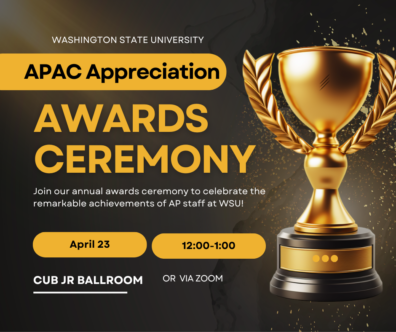
Did you miss us on April 23rd at 12:00 pm to celebrate the invaluable contributions of administrative professionals across the WSU system! In honor of National Administrative Professionals Day, we recognized six outstanding award winners for their dedication and excellence.
You can watch the award ceremony at your convenience, link embedded.
SmartHealth | Ann Monroe, Director, Benefit Services
 |
Get to Know the SmartHealth Benefits and how you can Earn the $125 Wellness Incentive! |
| The SmartHealth Program provides activities and resources that can help you on your Wellness Journey, focusing on a variety of topics associated with the various aspects of wellbeing – physical, financial, social, emotional, and spiritual While address your own self-care, you can earn points that will help you earn a $125 Wellness Incentive. | |
| Other Wellness activities: | |
| State Parks Activity: The state parks will be running their “State Parks” activities beginning June 1, 2025 through November 30, 2025. Stay tuned for more information as it is available. | |
| Financial Wellness: | |
| There will be webinars starting May 1, 2025 highlighting financial wellness | |
|
Webinars will begin on October 1, 2025 called “Decode your paystub” to help you make sure all deductions/contributions/abbreviations/etc. are correct prior to open enrollment. |
The History of Earth Day and the Climate of the Goldilocks Planet
| Speakers: |
| Allyson Beal King, Director of the school of the Environment |
| Julie Menard, Assistant Professor, School of the Environment |
U.S. Senator Gaylord Nelson is known as the Father of Earth Day. He said Earth Day, April 22, was designed to bring to national attention the deterioration of our environment and the mindless dissipation of our resources. Earth Day 1970 had an overwhelming response and resulted in 10 years of legislative changes that protected the environment in the United States. Earth Day 1970 did not, however, bring legislation to effectively address the carbon pollution causing climate change.
Researchers across multiple sciences are helping people understand impacts, and how to adapt and mitigate carbon pollution. The second part of this talk will describe how understanding other planets helps us better understand our own. Venus and Mars are our neighbors in the Solar System. They have volcanoes and an atmosphere, same as the Earth. The surface of Venus is very hot, the surface of Mars is very cold, and the surface of the Earth is somewhere in the middle. Why the big differences in climates? How does that knowledge help us better understand and preserve our planet and its lifeforms, humans included?